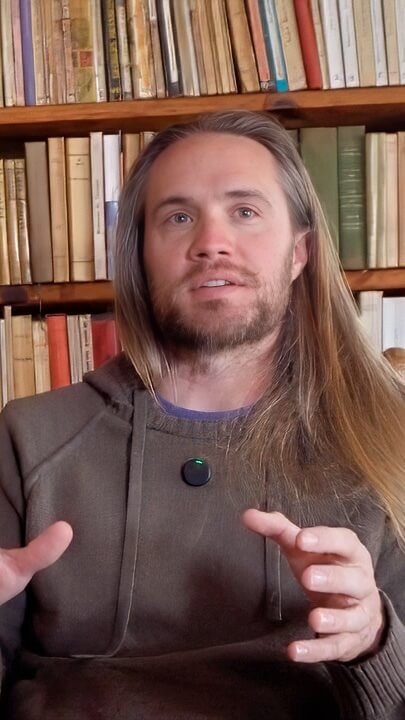
David Gwaltney is an Asheville-based artist whose practice spans music, film, and photography. Originally from Bristol, Tennessee/Virginia, David studied film at NYU before moving throughout the East Coast and eventually settling in Asheville, where he has lived for nearly a decade.
Though music has long been central to his work, David sees his creative output as a unified, interdisciplinary process. “It’s all one big pot of stuff,” he shared, describing how songwriting, visual storytelling, and sound recording evolved side by side—often beginning with home recordings made at fifteen and experiments with video at thirteen.
While at Azule, David entered what he described as a “closed phase” of his creative cycle—a time focused on editing, organizing, and completing work. This contrasts with his first residency at Azule, when he experienced a surge of generative energy. Last time, David created at multiple songs and filmed monologues in the woods. This time, he’s been cataloging old material and identifying what’s close to completion.
One song in particular has followed him for 15 years. Revisiting it now, he hopes releasing it might clear an emotional logjam: “If I can take that out, maybe that opens up the dam for more work to come.”
David finds deep inspiration in physical space and emotional introspection. The unique architecture and natural setting of Azule, along with personal processing, shaped this residency into a reflective, grounded chapter of his creative life.
His advice to other artists: “Recognize where you are in the process—and be okay with either phase.”
Video Interview
Transcript
I’m David Gwaltney. I live in Asheville, North Carolina. I’m originally from Bristol, Tennessee/Virginia, and then I went to NYU for film school and lived all over the East Coast for the next ten years. I finally ended up in Asheville, where I’ve been for almost ten years now.
What’s your focus as an artist?
I would ultimately say I’m an interdisciplinary artist. Music is very much at the core, but also filmmaking and photography. I really struggle because for a long time I identified mainly as a musician, and then at some point I realized it’s all one big pot of stuff.Can you talk about when in your life you began your pursuit? What led you there?
We were talking about that last night—when you ask that, do you mean when I started to learn piano at seven, or making movies when I was 13 with early digital video cameras? I started writing songs probably when I was 15 or 16 and learned how to record on my home computer. That led down one path. Film school was another path. Photography naturally came out of working with the camera and always having a camera around.Part of what drew me back here—this is my second time—is the place. One, the building itself is just so beautiful. Even just looking at this staircase right here, it’s just gorgeous. All the little details in this home feel really special. And then the land is quite beautiful.
Space is a big thing for me. A part of my art is emotional processing, if not some form of therapy. I came here hoping to process a lot, especially around Hurricane Helene and the subsequent six months of that, but then also other life things. Processing has been a sense of inspiration as well.
What have you been working on while you’re here?
I came hoping to process. The last time I was here, I made at least eight songs and recorded direct-to-camera monologues in the woods. I was hoping for that kind of explosion of energy.This time, I realized I need to finish things. I’ve been taking catalog of all my work and figuring out what’s close to being done—how it could be sorted: album, EP, single. Videos are whole other thing.
I’ve been looking at a song I’ve had for fifteen years. The recording is at least 90% there. I’ve just been adding a few more elements. For me, there’s a lot of emotional baggage caught up in that song. I’m hoping to finally let it go, and hopefully that opens things up. If that was a rock in a dam, I feel like it’s a big one. If I can take it out, maybe it opens up the dam for more releases to come.
Is there a best piece of advice you’ve received you’d like to share with other artists?
Oh my gosh. I don’t know. I will say that something I just heard last night—from Mike White, the writer-director of White Lotus and School of Rock—he was talking about how for him, the creative process comes in two phases: the open phase and the closed phase. That really resonates with me.The open phase being research and letting an idea gestate. The closed phase is the time of completion—getting to work and getting it to the finish line. The last time I was here was very much the open phase, where everything was just coming out. Anything goes. This time, it’s very much the focused on that closed phase.
I’ve learned I thrive in the open phase, and that it takes a little bit more work for me in the closed phase. So my advice for the person would be: try to recognize where you are in the process and be okay with either one. Productivity comes in many forms.