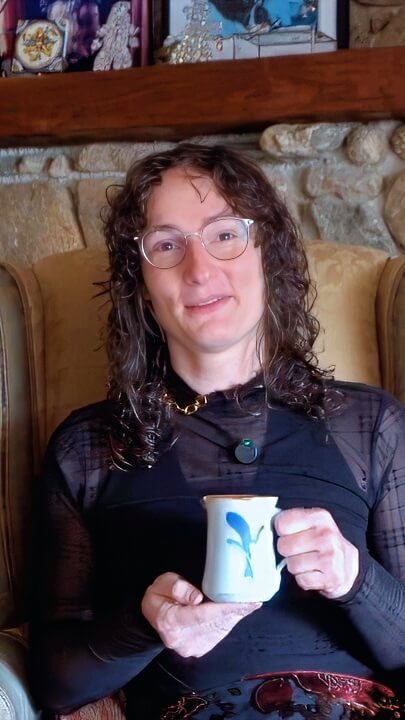
Eden Fenn is a writer focused on speculative fiction and fantasy, currently revising their novel The Candle at Both Ends. The story follows Soph, a young woman who lands a job at a mysterious nonprofit using magic books to fight climate change—at the cost of an hour of life for each spell. Drawing from personal experiences in mission-driven organizations, the novel explores themes of burnout, labor, and belief in a cause.
Originally from Massachusetts, Eden has spent most of their life in Baltimore and Philadelphia, and credits a strong creative community in Baltimore as a major influence. A long-running local writing workshop helped reignite their passion for storytelling after college and remains a consistent source of support and inspiration.
Their creative background includes songwriting and narrative design for video games, but they continually return to the written word for the freedom it offers. “Anything I can think to do in a story or a book, I can do myself,” they shared.
Eden is energized by setting—both imagined and real. While working on their novel, they’ve found fresh motivation in places built through sustained creative vision. Spaces shaped over time affirm the value of patience, a quality vital for anyone writing long-form fiction.
Asked for advice to fellow writers, Eden cited Anne Lamott: “Write shitty first drafts.” For them, embracing imperfection is essential to overcoming doubt and building a sustainable creative practice—reminding all artists that momentum begins with permission to fail.
Video Interview
Transcript
Can you introduce yourself and give us a little bit about your background?
My name is Eden Fenn. I am a writer, mostly of science fiction and fantasy, currently working on a novel. I was born in Danvers, Massachusetts, where the Salem witch trials happened, but I’ve lived most of my life in either Baltimore or Philadelphia. I’m back in Baltimore for the time being and loving it.I am revising a novel. The novel is called The Candle at Both Ends, and it’s a contemporary fantasy horror book about a young woman named Soph in her mid-twenties. She gets a job at this mysterious nonprofit that’s fighting climate change. They have these magic books that they’re using to do that work, and she discovers that each time the staff do magic, they have to pay with an hour of their lives.
It’s drawing pretty heavily from some experiences I’ve had in mission-driven organizations—exploring how companies or nonprofits with a strong mission focus like that can bring people in and then use that to extract a lot of labor, effort, and energy from them. It’s been a really fun book to write.
My agent gave me feedback on it a couple months ago, and I’m trying to knock out a full third of the book, revision-wise, while I’m here—and it’s going pretty well.
Can you talk about when in your life you began your creative pursuit and what lead you there?
That’s a great question. It’s embarrassing. I think the first time I really got it in my brain that I could be a writer was in middle school. I had an English teacher who was very focused on creative writing assignments, and I got a lot of praise and positive feedback from her.I think I responded very readily to that and thought, “Wow, this is something I’m good at, that I can feel good about.” Ever since then, I’ve been engaged in storytelling in different ways.
I’ve done a lot of music—not terribly well—but I’ve always been interested in the lyrical, narrative aspects of songwriting. I was briefly in a company trying to do narrative in video games, which was really cool and is still a great passion of mine. But I’ve always come back to written stories because it gives me such creative freedom. Anything I can think to do in a story or a book, I can do myself. I’m not limited by budget or the skill of other collaborators. I really feel like I can make the world as I want it.
Where do you typically draw your inspiration from?
I have a lot of really brilliant artistic friends, and I feel very enriched by the community in Baltimore that I live in. My friend Laura runs a writing workshop that got me back into writing after a college slump. We’ve been doing that for seven or eight years now. Being in creative community feels very inspiring and motivating to me.Seeing other people do the work is a great guide toward doing the work myself.
I also get a lot from setting. Being at Azule has been really, really cool. Just yesterday, we were talking about the incredibly delayed gratification of trying to write a novel. My last one I worked on for five years, and it still has not yet been published. This one I’ve worked on for a year and a half and counting.
There is a lot of patience and seeing the vision very far out that goes into choosing to do that and continuing to engage with it.
One of the cool things about being at Azule—besides the natural beauty—is it’s such a space that is a product of vision and a product of great creative passion and effort over a long sustained period of time. It’s like seeing what the work of decades can build, and how that long-delayed gratification work can pay off. People much later can come and receive it and have their lives be enriched by it.
Last question. Is there a best piece of advice you’ve received that you’d like to share with others?
Oh. The first one that comes to mind is from the writer Anne Lamott, who has a book on the craft of writing called Bird by Bird. I read it when I was probably 19. I don’t remember a lot of it, but I remember four words, and those four words are:“Write shitty first drafts.”
Prior to encountering that—and I still wrestle with it for sure—I think there is a lot of resistance that artists have within themselves in terms of worrying the work won’t be good enough or not feeling like they’ve received the creative muse.
I have found that just allowing myself to do something badly and allowing myself to fail is a great way to build a practice and build momentum—and not get paralyzed in self-doubt before I’ve even created anything.
If the first draft does end up being shitty, it’s much easier to go back and improve something that exists than to still be looking at the blank page.