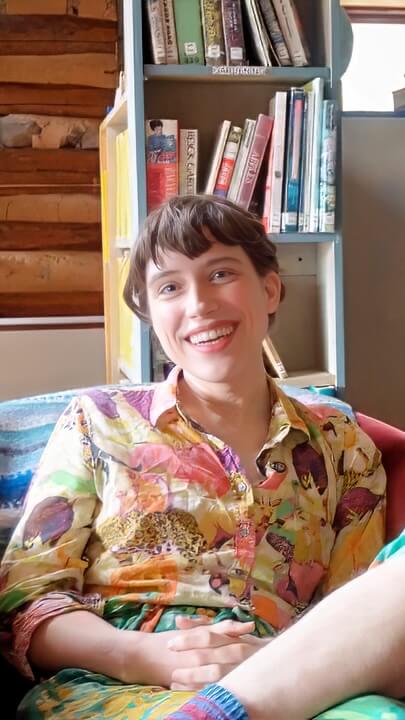
Laura Grothaus is a multidisciplinary artist whose creative journey began with a childhood poem written for her younger brother. Today, she lives in Baltimore and works at the intersection of fiction and visual art, exploring themes of labor, mythology, and speculative futures. Her current focus is a novel and collection of short stories that imagine the next 50 years through the lens of union organizing and collective action.
Laura’s creative process is deeply intuitive and rooted in curiosity. She often begins with an abundance of ideas, mapping them out on index cards to discover what resonates most. Her latest project emerged not from a single concept, but from the act of reflection itself—choosing a path that felt both fulfilling and sustainable over time. She believes that the process of making must carry as much meaning as the final product, especially in longform work like a novel.
Her background in visual art feeds her writing. A recent altered book project, where she carved and transformed books into sculptural forms, allowed her to step away from language while still shaping narrative—revealing how intertwined her practices are.
Influenced by writers like Ursula K. Le Guin and Octavia Butler and inspired by folklore and fairy tales, Laura draws from a deep well of both research and lived experience. When asked what advice she’d offer other artists, she reflected on the importance of finding confidence and joy in the work—and staying open to the possibility that life can be good.
Video Interview
Transcript
My name is Laura Grothaus, and I am a writer and visual artist.
I live in Baltimore, Maryland right now. I grew up in Cincinnati, Ohio, and I am working on a novel and short stories right now about speculative, next fifty years future, and specifically about labor organizing and unions.
So I was always interested in creativity and writing and art. And I remember first starting to write poems around the time I was eight years old. I wrote a poem about reading to my little brother who was five years younger than me and just kind of has grown as an interest from there. I’ve always really enjoyed how creative pursuits thread together and intertwine with each other.
And so for me, I’ve often had—I’ll give an example. A couple years ago, I started an altered books project where I was hollowing out the center of books and visually forming the components of the story to put them in. That has felt like it really feeds some of my writing practice, where I get to have a balance of not having to deal with words and then getting to return to words and all that they offer.
With this particular project—the novel and short stories—I knew that I wanted to do a longer project, that I wanted to work on a novel. Often in my process, I have maybe too many ideas, rather than too few. So the idea of, what do I choose? What do I work on?
Since the novel is such a dedicated amount of time, and I really think that time is a hugely valuable resource—and I devote so much of it to community and friends and paid work—I really wanted to be intentional about it.
So with this project, I did this process of finding clearness about what I wanted to work on and wrote on index cards every idea I had for stories—what they would offer me, what they might offer other people, and what I could imagine happening inside of them.
Through that process, as I studied more and more to see what spoke to me among those various factors, this book emerged. I actually didn’t write it down on a note card. Through the process of looking at all of these ideas, I realized I want to work on this one. It just kind of came to me through that process—that this was the thing I wanted to do. Part of that was also: if you’re working on a novel, the process has to be as fulfilling as the final product, because it could very well never see the light of day.
I thought, if I’m working on a novel about the history of unions that is also about the future of them, I get to do really interesting research and talk to really fascinating people. I’ve interviewed friends who are involved in that kind of organizing, old timers who did it for many years and are now retired members of labor choruses. It’s been very cool to get to do the research and have that be a fulfilling part of it too.
So that was the beginning of my creative journey all the way through to this present project.
Where do you typically draw your inspiration from?
Great question. I think it’s a mix of things.For a long time, I was really inspired by myth and fairy tale and really old stories that humans have told for centuries—thinking about how we retell them now and what significance they’ve held for us.
More recently, with this project in particular, it’s a mix of the research that I’m doing and the compost heap of my brain—everything I’ve ever experienced and what grows out of there.
For me, as a writer and visual artist, a lot of the work that inspires me is work that plays with speculative elements that may have their origin in fairy tale and folklore. Writers like Ursula Le Guin and Octavia Butler, and painters like Remedios Varo—people who are interested in how you express the weirdness of our lives or imagine the magical possibilities of the far reaches of our world and brains.
Also, I’ll say being at Azule, walking around and getting to see the art that other people have made, and the amount of collaboration that has gone into this place—and then getting to walk around the land around it and seeing these mountains, some of the oldest on Earth—being in places like that is really inspiring.
Last question. Is there a piece of advice that’s the best you’ve received or would like to share with other artists?
I’m really considering this. It’s a great question.I think there’s a couple that come to mind. One is I heard George Saunders speak once, and he talked about finding the place in your work where you feel really confident—where when you sit down to do the work, you come to it with a sense of maybe not joy exactly, but maybe joy, and a sense of peace, perhaps.
I think that’s really huge for artists. I think oftentimes people are taught to approach work with a sense of gritting your teeth and angst. Work we make can be painful to produce, but finding a place where sitting down to do it isn’t like pinching yourself over and over again—finding the places where you feel confident and finding the moments for joy in it—that comes to mind.
I also—maybe strangely—am thinking about this thing my mom told me once. I was on a walk, and she said, “Laura, I think you think your life is destined to be complicated. Maybe it’s just destined to be good.”
And I was like, whoa. I still think my life is destined to be complicated, but sometimes maybe I could entertain the possibility that it’s just destined to be good.
So those are the two pieces of advice that come to mind for me.